
Book Series
Two open access book series in criminology, victimology, law and the social sciences. Book proposals are welcome now.
Our series
Advances in Criminology and Victimology
Advances in Criminology and Victimology publishes open access books that advance the study of crime, victims and justice. The series welcomes monographs, edited volumes, textbooks and study guides that develop theory, report original research or bring the knowledge of the discipline within the reach of students and practitioners.
It gives equal weight to the offender and the victim, since criminology without victimology tells only half the story. The series welcomes work across all areas of criminology and victimology, and it looks ahead to the new fields that emerge as crime itself changes, from cyber criminology and cyber victimology to areas yet to be named.
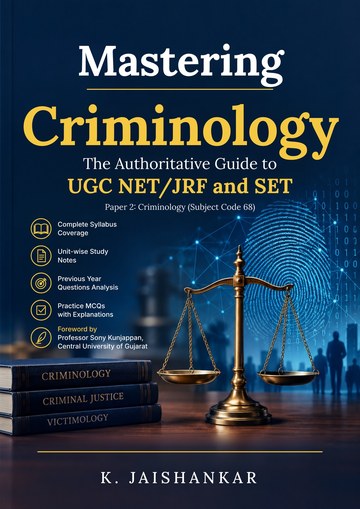
Mastering Criminology: The Authoritative Guide to UGC NET/JRF and SET
Law and Social Sciences Book Series
Published in collaboration with the International Institute of Justice and Police Sciences (IIJPS), the Law and Social Sciences Book Series highlights the intersection of law and the social sciences. It encourages interdisciplinary scholarship that examines how law, legal institutions and justice systems interact with society, culture, politics, economics and social change.
The series welcomes theoretical, empirical, comparative and applied research that bridges legal studies with the perspectives of the social sciences.
Why publish with us
- Fully open access: every book is free to read and download, anywhere in the world
- An ISBN and a DOI for every book, with a permanent copy on Zenodo
- Print copies provided to authors
- Peer review of every proposal and manuscript
- PhD thesis-to-book proposals welcome
- Special encouragement for early-career researchers
How to submit a book proposal
Send your proposal as a single Word or PDF file to jaishankar@justicepoliceinstitute.org, with the subject line “Book Proposal: [Your Title]”. The proposal should include:
- Title and series. The proposed title and subtitle, and the series you are submitting to.
- Type of book. Monograph, edited volume, textbook, handbook, or a PhD thesis to be revised into a book.
- About the author or editors. Name, designation, affiliation, email and ORCID for each author or editor, with a short biography of about 150 words and a current CV.
- Synopsis. 500 to 1,000 words on the aims, scope and central argument of the book, and its contribution to the field.
- Originality. How the book differs from existing works, naming three to five comparable titles.
- Readership. The intended readers, such as researchers, postgraduate students, practitioners or policymakers, and the courses for which the book may be used.
- Table of contents. A detailed chapter list, with an abstract of 100 to 200 words for each chapter. For edited volumes, also give the names and affiliations of the confirmed contributors.
- Sample chapter. One complete chapter. For a thesis-to-book proposal, attach the thesis and a short plan of how it will be revised for a wider readership.
- Length and timeline. The expected length in words, the number of figures and tables, and the date by which the full manuscript can be delivered.
- Declarations. A statement that the work is original and has not been published or submitted elsewhere, and that permission has been or will be obtained for any third-party material. For a thesis, confirm that you hold the right to publish it.
- Suggested reviewers (optional). Two or three experts in the field who have no conflict of interest.
Review, licence and fees
Review process
The series editors first screen each proposal for its fit with the series. Proposals that pass are sent for peer review, and authors receive the reviewers’ comments. On acceptance, the full manuscript is also reviewed before publication.
Licence
All books are published under the Creative Commons Attribution-NonCommercial-NoDerivatives 4.0 International licence (CC BY-NC-ND 4.0), so readers may share them freely, with credit to the authors, for non-commercial purposes and without changes.
Publication fee
A publication fee applies; details are shared on acceptance of the proposal.